


BIM adoption looks solved.
The NBS Digital Construction Report 2025 puts usage at 74% of architecture professionals, with nearly 88% of the industry using it or planning to.
But adoption is not implementation. Inside design-led studios, BIM keeps failing.
Models nobody trusts. Standards nobody follows. One knackered 'Revit dude' holding delivery together.
The research says the software is not the reason. Studies put the top barriers in the same column: Resistance to change. Weak leadership alignment. Missing training. Incentives that don't pay for the work.
A 2025 study of design engineers found inertia, the pull of the current way of working. Is the single strongest driver of resistance.
McKinsey has spent a decade showing that roughly 70% of transformations fail, and that culture beats technology as the obstacle every time.
BIM fails in design-led practices because it rewards early decisions, consistency and information discipline.
Design culture rewards late refinement, flexibility and visual quality. The values are diametrically opposed. The eventual collision is nobody's fault and everybody's problem.
Here's why it matters now: the same collision is being rehearsed again with AI.
RIBA's AI Report 2025 shows 59% of practices using AI. Up from 41% in a year.
While only 15% have an AI policy and fewer than one in five have invested in building capability. Tools in, culture unchanged. That's the BIM mistake, replayed at higher speed.
The fix is not to be less design-led.
It's a handful of boundaries, standards and incentives that let design excellence and information discipline coexist.
Walk into a strong design-led studio. You'll find the awards on the wall and the dysfunction in the model.
The BIM? Late, inconsistent, held together by one person who dreads Thursdays. The schedules lie. The consultants have stopped trusting the exports. Every deadline is survived rather than delivered.
The comfortable explanation is a skills gap: architects are artists, the software is hard, 'send everyone on a course'.
That explanation has been tested for fifteen years and it keeps failing The practices with the best-trained teams still hit the same wall.
The uncomfortable explanation is the true one. BIM is an information management system. It rewards consistency, standards and early commitment. Design-led culture rewards intuition, flexibility and late refinement. When those value systems meet with no consensus. BIM loses, eventually the studio loses with it.
It was never a software problem. The reason to care in 2026? The identical collision is now happening with AI, at a pace that leaves no room to recover.
The resistance isn't stupid.
Let's start there, because most writing on BIM adoption doesn't.
When a design-led studio pushes back on BIM, it's pushing back on real costs.
BIM front-loads effort into the stages where fees are thinnest. It asks for decisions at RIBA Stage 2 that the design process wants to hold open until Stage 4.
Its standards read as constraints on the exact freedom the studio sells. The benefits land on other people's spreadsheets. The contractor's rework budget. While the cost lands on the studio's timesheet.
A 2025 study of design engineers made this precise. The strongest driver of resistance wasn't fear of technology, it was inertia. The gravitational pull of the current workflow. Followed by a fairness question the researchers call distributive equity: 'Who does the extra work, and who gets the benefit?' In most BIM implementations the honest answer is: You do the work, someone else gets the benefit.
So the architect dragging their feet is not a Luddite. They're responding to the incentives in front of them. Any fix that doesn't change those incentives is a poster on the wall.
Now the harder truth. The resistance is rational locally and ruinous globally.
The thing being resisted is the only version of the practice that survives what's coming.
If BIM failed for technical reasons, the failures would cluster around the technology.
They don't.
They cluster around the organisation.
Look at the adoption numbers first. The NBS Digital Construction Report 2025 has 74% of architecture professionals using BIM, and nearly 88% of the industry using or planning to use it. The tools are bought. The training courses have been run. Adoption, as a purchasing question, is over.
Yet inside practices the same failure pattern repeats, and the research keeps returning the same list of causes:
Organisational and cultural barriers rank as influential as, or more influential than, technical ones. Across countries, across firm sizes, across a decade of surveys.
Zoom out and the pattern gets bigger than BIM. McKinsey's transformation research has held one number for years. Roughly 70% of change programmes fail, and the biggest obstacle is culture, not technology. BIM in a design-led practice is a change programme. Treat it as an IT purchase, you've bought a 70% failure rate with your subscription.
One more number worth holding. Small practices. NBS puts BIM adoption at 56% for organisations of 15 staff or fewer, with 23% saying they have no plans to adopt it at all. That's not a verdict on small studios' talent. It's a verdict on what happens when the cost of the discipline is visible and the return isn't.
The software was never the problem. The system around it was, and is.
Here's the collision in one table. Everything else in this post is a footnote to it.
What design-led culture rewards | What BIM and AI reward |
|---|---|
Late refinement - keep options open | Early commitment - decide, then develop |
Intuition and taste | Consistency and structure |
The exceptional one-off | The repeatable standard |
Visual quality - how it looks | Information quality - whether it's true |
Individual brilliance | System resilience |
‘We'll resolve it later’ | ‘Later is where the cost lives’ |
Neither column is wrong. The left column produces architecture worth publishing. The right column produces buildings that get built on budget. A practice needs both — and most design-led studios have quietly organised themselves so the left column always wins.
BIM fails there not because it's badly configured but because it's an ambassador from the right column, negotiating without leverage.
The MacLeamy curve is old.
Design-led practices still refuse to believe it applies to them.
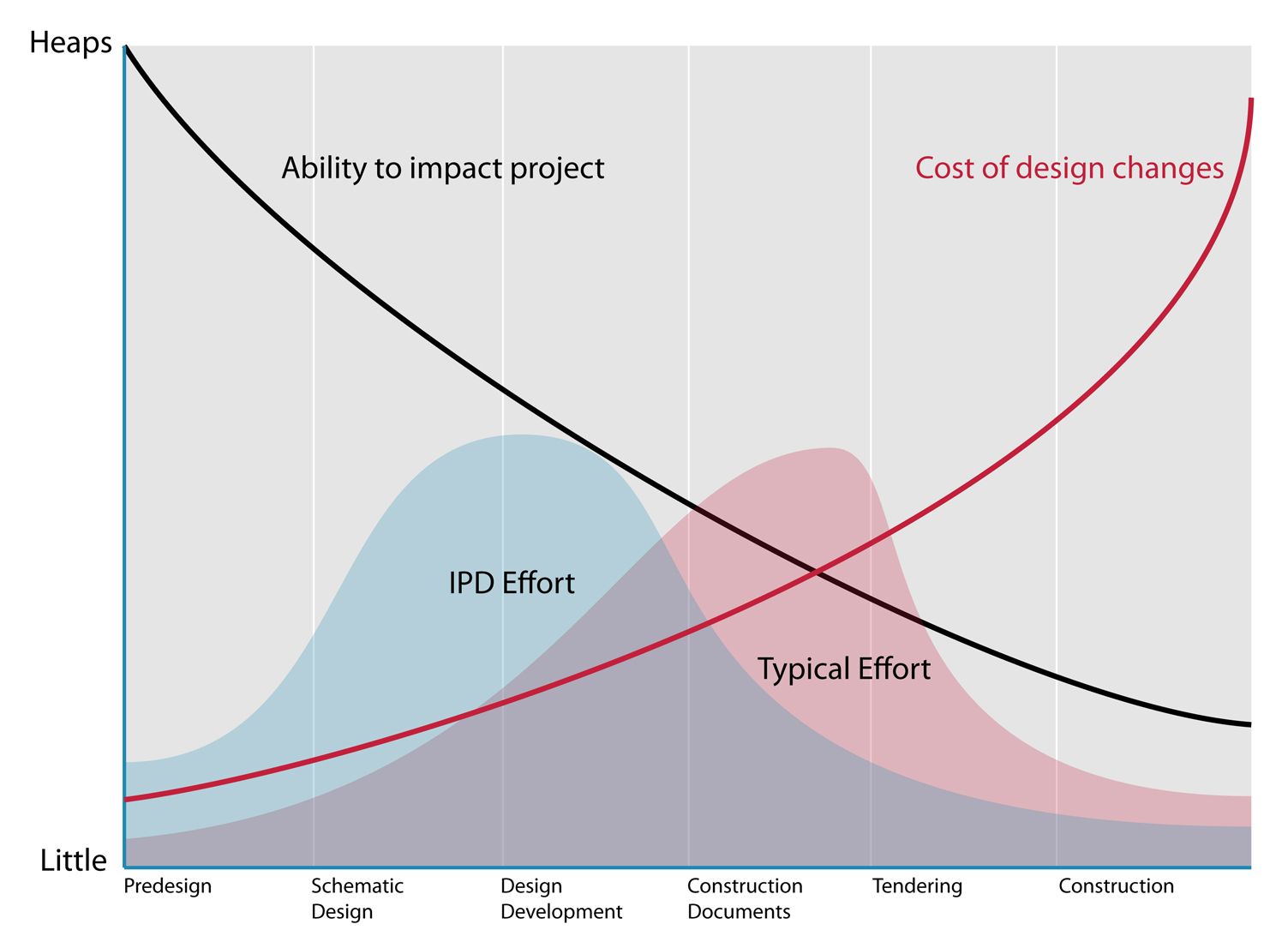
Its logic hasn't moved. As a project progresses, your ability to influence the outcome falls while the cost of change rises. BIM front-loads effort to exploit that curve.
Then let documentation flow downhill from stable decisions.
Design culture runs in the opposite direction. Ambiguity isn't laziness in a studio. It's a method. 'We'll resolve that later', is how good buildings stay open to becoming better ones. The problem is that BIM charges full price for 'later'. The bill is brutal.
A Stage-4 change to a Stage-2 decision cascades through the federated model, the schedules, the sheets, the consultants' models, and the fee!
The evidence for front-loading has been measured.
Hong Kong ran the experiment on public housing. BIM projects spent about 46% more at design-stage. Then the build-stage came in 8.6% cheaper per square metre. That trade sounds bad until you remember the sizes:
Pay more into the small number. Take more out of the big one.
And that's before rework. Rework eats 5–15% of project cost across the industry. Autodesk and FMI traced $88.69 billion of it, in one year. To bad information alone. That's the bill for deciding late.
The fix isn't 'decide everything early.' That kills the design process, and it isn't what the curve asks for. The fix is a decision boundary. A short, explicit list of what must be locked early because everything hangs off it. A protected zone of what may stay fluid because nothing structural depends on it. Studios that draw that line keep their method and lose the dysfunction. Studios that don't are betting the fee that the curve is wrong.
It never is.
The most common BIM implementation in a design-led practice is one hire.
'We need a Revit person'. I've seen this personally. I've even been that guy.
The studio recruits one, and that person becomes the BIM strategy:
The practice calls this, 'having BIM''. What it has is a dependency with a notice period.
The tell is what happens when that person goes on holiday. If information quality collapses in a week, the studio never had a BIM system . It had a hero.
Heroes burn out, leave, or become bottlenecks, and every one of those endings takes the practice back to zero.
A system is smaller than people fear. It's four things:
None of that needs a bigger practice. It needs one decision: information management is a workflow, not a person.
Hire the person by all means.
But hire them to build the system, not to be it.
Say 'naming conventions' in a design review and watch the room's eyes glaze over.
In a studio that values freedom, standards read as captivity on a job.
Reverse the frame. Every hour the team spends untangling a mislabelled model, rebuilding an ungoverned family, or hand-checking a schedule that should have checked itself is an hour subtracted from design. Weak standards don't protect creativity. They tax it. Then pay the proceeds to cleanup.
The mechanics are unforgiving. Automation collapses without consistent data: scripts can't find what isn't named, schedules lie when parameters are incomplete, and coordination becomes manual detective work. This is precisely what ISO-19650 exists to prevent. Not paperwork for its own sake, but an information backbone that makes every downstream tool work. McKinsey's construction research says the same from the business side: BIM's value scales when data and reporting formats are standardised, and stalls when they aren't.
Here is the 2026 twist that raises the stakes: AI runs on the same backbone. A machine-readable model is one an AI can audit, query and check. A folder of beautifully rendered inconsistency is invisible to it. Every naming convention the studio skipped in 2020 is an AI capability it can't use in 2026.
The standard was never the constraint. The cleanup was.
BIM asks for investment.
Nobody pays for it though!
Most design-led practices absorb it without changing a single commercial term.
The predictable result: BIM becomes 'extra work for the same money'. The team's resentment is arithmetic, not attitude.
Remember the fairness finding from Section 1.
Resistance tracks 'who does the work versus who gets the benefit'. Fix that and much of the 'culture problem' dissolves without a workshop.
Practically, that means tying the discipline to numbers the studio already cares about, and pricing it:
A studio that does this stops asking people to be believers. It asks them to read a number.
Numbers are easier to recruit.
Everything above would matter on its own.
It matters more because it's happening again, faster, with a different noun.
RIBA's AI Report 2025 reads like the early BIM surveys with the dates changed.
59% of practices now use AI, up from 41% a year earlier. Large practices are past 80%; small studios sit at 48%.
Underneath the adoption, fewer than one in five practices have invested in any research or capability building. Only 15% have a formal AI policy. The 2026 surveys of AEC firms fill in the rest. The barriers aren't cost. They're culture, integration and trust in outputs.
Recognise the pattern?
Tools in, culture unchanged. Individual architects prompting image generators and drafting specs with chatbots. while the practice has:
That is adoption without transformation. The exact move that turned BIM into shelfware with a licence fee, now replayed on a technology that compounds.
The price of resistance has changed. BIM punished an undisciplined practice with rework. Painful, expensive, recoverable.
AI punishes worse.
Here's the irony worth sitting with.
The design-led studios that resisted BIM because it threatened their craft are now adopting AI in a way that guarantees it can't help their craft. The resistance didn't protect the design culture.
It just delayed the payoff and doubled the bill.
None of this requires the studio to be less design-led.
It requires six moves, each of them boring, each of them evidenced by the failure modes above.
1. Draw the decision boundary.
The curve says early decisions are cheap and late ones are ruinous. The boundary lets you obey the curve without surrendering the method.
2. Set minimum viable standards — one page, co-designed.
Not the 60-page manual nobody reads.
The change-management literature has said so for decades, and the BIM surveys confirm it. Then bake the standards into templates so the right way is the easy way.
3. Pilot one stage of one project, and measure it.
Big-bang rollouts are how 70% of transformations die. Pick a project, pick a stage, record rework hours, RFI count and hours-per-sheet before and after. The pilot's job isn't to be perfect. It's to replace faith with a baseline.
4. Appoint champions, not police.
The best enforcement is a default that's easier than the workaround.
5. Price the discipline.
Until the person doing the extra work sees the benefit, every survey says you'll get resistance. Until then, resistance is the rational position.
6. Run information QA next to design QA — and give it to the AI.
The studio already reviews the design every week.
Auditing a model is exactly the tireless, repetitive, judgement-light work AI does well, and exactly the work your team hates. Let the architects keep the taste. Give the machine the checklist.
Do these six and the two value systems stop fighting. The left column keeps the intuition, the late refinement where it's safe, the exceptional one-off. The right column quietly guarantees the information underneath it is true.
Why does BIM fail in architecture practices?
Rarely for technical reasons.
The research consistently ranks organisational barriers highest. Resistance to change, weak leadership support, missing training, standards nobody co-designed, and incentives that don't pay for the extra work. BIM is a change programme; treated as a software purchase, it inherits the ~70% failure rate of unmanaged change.
Is BIM worth it for small, design-led studios?
Yes. With a caveat about dosage. NBS data shows small-practice adoption at 56%, well behind the industry, and the gap is rational: the cost is visible and the return isn't. The answer is minimum viable BIM: one page of standards, a decision boundary, three measured numbers. The 60-page corporate BEP is what's not worth it for a ten-person studio.
Why do architects resist BIM?
Because the incentives tell them to. Studies show the strongest drivers of resistance are inertia and perceived unfairness. The architect does the extra structuring work, and the benefit lands with the contractor or client. Fix the equity (scope it, fee it, return the saved hours to design) and most resistance evaporates without a single motivational workshop.
Will AI fix a practice's broken BIM?
No. it will accelerate it. AI is an amplifier: pointed at clean, structured, machine-readable models it audits, checks and queries at a speed no human can match. Pointed at ungoverned data it produces confident errors faster. The order of operations is fixed. Information discipline first, AI second. There is no tool-shaped shortcut around that sequence.
How do design-led practices adopt AI without losing their design culture?
Start where AI threatens nothing: information QA. Model auditing, parameter checks, naming compliance, clash surfacing. Repetitive checking work the team already resents. That builds trust and skills while the design process stays human. What doesn't work is the current default. RIBA found 59% of practices using AI while only 15% have any policy. Individual experimentation with no standards, no measurement and no plan. That's adoption without transformation, and it's the BIM failure with a faster clock.
If BIM keeps failing in your studio, the team isn't the problem and neither is the software.
The system is.
The unexamined mix of late decisions, unpriced discipline and ungoverned data that every deadline exposes.
The Bimcopilot AI + ISO-19650 Integration Audit examines it.
We map where your information breaks. Naming, federation, CDE, model acceptance, data flow, and where the failure is cultural rather than technical.
The decisions made too late, the standards nobody owns, the work nobody priced. Then we show you where AI closes the gap, starting with the checks your team shouldn't be doing by hand.
What it covers:
You built a practice that produces exceptional design. The audit makes sure the system underneath it isn't quietly taxing every hour of it.
Book a Bimcopilot AI + ISO 19650 Integration Audit https://bimcopilot.com/services — or talk to us first https://bimcopilot.com
BIM fails in design-led practices for one reason wearing five disguises.
The practice's value system rewards what BIM punishes and punishes what BIM rewards.
Late decisions meet an early-decision system. A hero substitutes for a workflow. Standards read as constraints. Nobody prices the discipline. And the model is judged by how it looks instead of whether it's true.
None of that is a software problem, which is why fifteen years of better software hasn't fixed it.
AI is entering design-led studios the way BIM did. Tools first, culture never.
This time the penalty for resistance isn't rework, it's the compounding gap between practices that govern their information and practices that generate it.
Design excellence and information discipline were never enemies. One of them just kept arriving without an invitation.
Write the invitation, and BIM stops feeling like bureaucracy and starts behaving like what it always was underneath. Leverage.